Most service businesses don’t lose work because they’re bad at the work. They lose it in the gaps — an inquiry that never got a reply, a proposal that was never followed up, an invoice that slipped a month. Deal management is how you close those gaps. Here’s what it means for a service business in 2026, and how to do it well.
What is deal management?
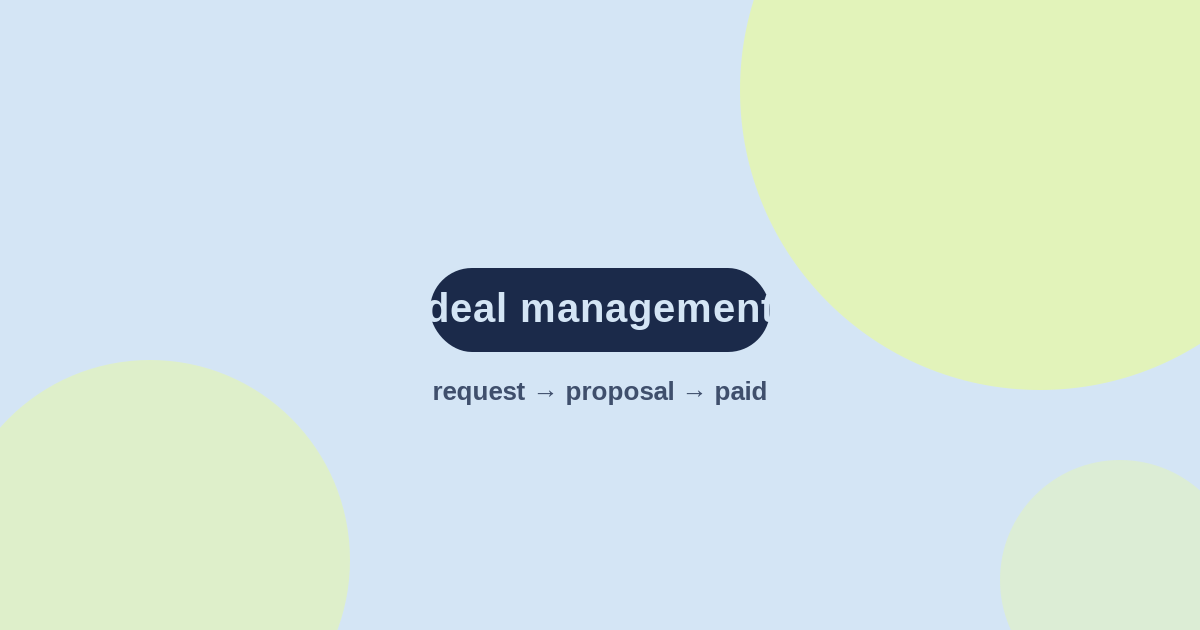
Deal management is the practice of tracking and moving every potential job from the first “hello” to getting paid. It covers qualifying the inquiry, sending a quote, agreeing terms, invoicing, and closing the deal — with visibility at every step so nothing stalls.
Deal management vs a CRM
A classic CRM is built for sales teams to log calls and notes against contacts. That’s tracking activity. A service business needs to run the deal itself — the proposal, the contract, the invoice, the payment — not just record that a lead exists. Deal management is the doing, not just the logging.
The stages of a service deal
- Inquiry / request — someone asks about your service. Capture it structured, not as a loose email.
- Qualification — scope, budget, timing. Is it a real job?
- Proposal — a clear, priced quote, sent fast.
- Contract — agreed terms, signed.
- Invoice & payment — billed and collected, ideally with a deposit up front.
- Delivery & close — work done, final payment, deal closed.
Where deals leak
- Inquiries buried in an inbox with no structured capture.
- Slow quotes — the fastest proposal usually wins.
- Manual hand-offs between separate tools for chat, proposals, contracts and invoices.
- No follow-up because it depends on someone remembering.
- Work delivered before payment is secured.
What good deal management looks like
One place for the whole deal. Every inquiry becomes a structured request; the proposal, contract and invoice stay attached to it; reminders are automatic; and payment is built in. No tool-switching, no re-typing, no deals quietly dying between steps.
How ReqMe handles deal management
ReqMe is built as one space for deal management: your AI agent qualifies every inquiry into a structured request, turns it into a proposal and contract, and issues the invoice with payment attached — at a 0% platform fee. The whole deal, from first hello to paid, lives in one flow instead of scattered across five tools.
Frequently asked questions
What is deal management?
Deal management is tracking and moving a potential job from first inquiry through to getting paid — qualifying it, quoting it, agreeing terms, invoicing, and closing it out — so nothing stalls or falls through the cracks.
How is deal management different from a CRM?
A traditional CRM is built for sales teams logging activity against contacts. Deal management for a service business is about running the actual deal — proposal, contract, invoice, payment — not just recording that it exists.
What are the stages of a service deal?
Typically: inquiry/request → qualification → proposal → contract → invoice → payment (and delivery). Good deal management keeps all of these in one place with no manual hand-offs between tools.
How do I stop losing deals in my inbox?
Capture every inquiry as a structured request, quote fast, and keep the proposal, contract and invoice attached to the same deal with automatic reminders — so follow-up never depends on someone remembering.
Run your whole deal in one place
ReqMe runs the full client deal — request, proposal, contract, invoice, payment — in one flow, at a 0% platform fee. See how getting paid works or what AI service management is.